
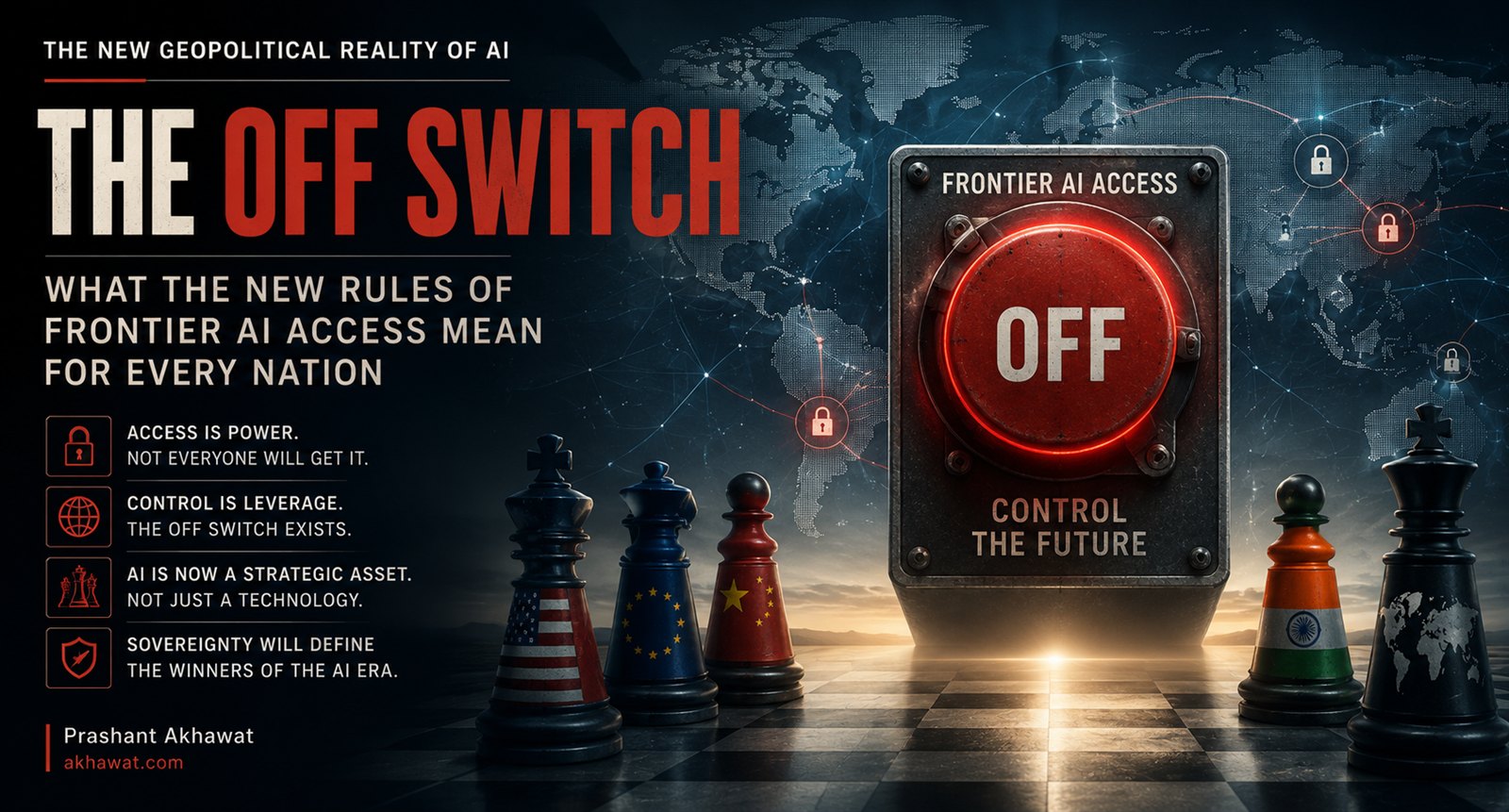
The Facts
What actually happened in June 2026
Strip away the model names and the pattern is stark. In one month, two of the three leading American AI labs had their frontier capability gated by Washington.
On 9 June, Anthropic launched Fable 5 and Mythos 5, its most advanced models. Three days later the Commerce Department ordered it to suspend access for any foreign national, citing national security. Anthropic complied the only way it technically could, disabling the models worldwide, reportedly even for its own foreign-national staff.[1][6] This appears to be the first time export-control machinery, the same apparatus that cut China off from advanced chips, has been aimed at a language model.
On 26 June, still unresolved, the government let Anthropic re-open Mythos 5 to roughly one hundred U.S. critical-infrastructure firms and agencies, while Fable 5 stayed offline.[2] The same day, OpenAI launched GPT-5.6 and limited it to about twenty trusted partners at the government's request.[3][4] OpenAI said publicly it does not believe this kind of access process should become the default.[5] Restoration to a vetted few, rather than a clean reversal, is the point. Access had become something re-granted in slices.
The basis is disputed, which matters for what follows. Anthropic says the directive rested on a narrow jailbreak whose capability is available from other deployed models, including GPT-5.5.[1] The episode also sits inside a longer friction. Earlier in 2026 the Department of Defense labelled Anthropic a supply-chain risk, a designation usually reserved for foreign adversaries, after contract talks collapsed.[4][6] The point is not to adjudicate the quarrel. It is that the machinery now exists and has been used.
From public launch to blackout to selective re-grant in 17 days
The Reframe
The world is panicking about the wrong switch
The instinctive fear is that America can turn off our AI. That fear is real but badly aimed. Two corrections change the entire strategic picture.
Correction 1. Only the apex was touched, not the economy
What was restricted is the top sliver of the capability curve, for high-risk domains such as cybersecurity, biology, and advanced agentic coding, for a window of weeks. It did not touch the previous-generation models, the open-weight ecosystem, or anything already embedded in production. The overwhelming majority of enterprise AI value, including document intelligence, support, summarisation, code assist, and retrieval, runs perfectly on models a generation or two below the frontier. A frontier blackout is a wound to the strategic apex, not to the broad economy.
It is fair to ask what the apex buys that a strong open model does not, because if the answer is nothing, the worry dissolves. For most tasks the gap is shrinking and will not matter. The apex matters in the narrow set of contests where being a few months ahead is the capability. The clearest case is cyber. A model that autonomously finds and chains novel vulnerabilities faster than the other side can patch is a strategic asset, and a six-month lead is the difference between systems breached or defended. The same logic holds for bio-design screening and large-scale intelligence analysis. For these, a capable-but-trailing model is no substitute, because the entire value is the margin over an adversary. That set is small. It is also the set on which national security turns, which is why it cannot be left to whatever access a foreign government allows. And it need not stay small: as agentic systems take on more consequential work, capabilities that are merely convenient today will migrate into the band where the margin matters. The exposure map is a snapshot, not a fixed state, which is an argument for building the capacity to act before the apex widens.
Where the restriction actually bites
Correction 2. For regulated industries, the danger is invisible, not absent
This is the dimension the geopolitics commentary misses. When Fable 5 was briefly live, it did not simply block sensitive prompts. Its classifiers silently down-routed them to an older, weaker model, returning degraded answers with no signal to the user. For a consumer chatbot that is an annoyance. For a workflow validated under 21 CFR Part 11, EU Annex 11, GAMP 5, or ISO/IEC 42001, a silent capability swap is something else entirely.
For a regulated enterprise, a silent model downgrade is not an outage. It is a compliance event. It triggers revalidation, deviation handling, and audit exposure. The cost is measured in liability, not latency. The distinction every CISO and quality lead should internalise
API access is not strategic control. A team that builds around a frontier model inherits its access risk, its compliance risk, and its continuity risk. As AI gateways become production infrastructure, that inherited risk moves from the lab into the core of the business and the state.
The Enterprise View
What a silent model swap does inside a regulated workflow
The geopolitics story stops at the border. The operational story starts where most analysts never look, which is inside the validated systems that regulated enterprises run every day. To see why a silent down-route is so much worse than an outage, follow one concrete workflow.
A worked example. Pharmacovigilance case triage.
A life-sciences company runs an AI step that reads incoming adverse-event reports, classifies seriousness, and routes urgent ones for expedited reporting inside a legally mandated clock. Under GxP and 21 CFR Part 11 that step is validated. The company holds documented evidence that this specific model, at a known version, performs to a measured standard, and an auditor can demand it at any time.
Now the provider's classifier silently decides the input touches a sensitive biological topic and routes it to an older, weaker model. Nothing fails. No error appears. The answer looks normal but came from a system the company never validated. For days, seriousness classifications may be subtly wrong, an urgent case mis-ranked, a reporting clock missed. The first anyone learns of it is an audit finding, long after the fact.
An outage you can see. A silent swap you cannot.
Why this is categorically different from downtime
An outage is visible and bounded. The system is down, you know it, you fall back, you resume. A silent swap is none of those. It is an undocumented change to a validated system, among the most serious events in regulated terms. It triggers revalidation, a deviation investigation, an assessment of every decision made in the affected window, and possible disclosure to a regulator. The cost is not the minutes of degraded service. It is the liability and the erosion of the audit trail the whole compliance posture rests on.
Any model in a regulated workflow must guarantee version transparency and prohibit silent substitution. If the provider cannot promise that the model you validated is the model that answers, the integration is not audit-ready, however capable the model is. The sharpest form of this is regulated, but the principle generalises. Any organisation with version-dependent behaviour, SLAs, or reproducibility requirements faces a softer version of the same exposure.
The New Order
There is no "rest of the world." There is a hierarchy of permission
The most important factual correction of all is that Washington did not single out any one country. It split the planet into tiers of access. Treating everyone outside the allowlist as one undifferentiated group hides the real structure, and the real structure is where leverage lives.
A caveat worth stating plainly. These tiers are not a formal, published designation. No government has drawn this pyramid. It is the structure the events imply, inferred from who actually received access and who did not. The labels are an analytical lens, not an official register, and the membership will shift as negotiations move. The value of the lens is that it replaces a vague sense of exclusion with a concrete question any nation can act on, which is which tier it occupies and what it would take to move up one.
Frontier AI now has haves, allies, partners, and everyone-else
For the first time, the most powerful general-purpose technology on Earth is not something nations own. It is something they are permitted to use. And permission can be revoked.
There is an uncomfortable parallel that every partner nation should sit with. The instrument now being pointed at allies and friends is a softer version of what was first built for China. The same Commerce Department authority that cut Beijing off from advanced chips is the one that gated these models, and the move arrives after years in which Washington's stated goal was the opposite, to diffuse the American AI stack everywhere and make it indispensable.[11] The reversal is the signal. If access can be reclassified this quickly for partners, then no nation outside Tier 0 should treat its current access as permanent.
The Constraints That Bind
The real chokepoints are chips and electricity, not models
Models can be hedged with open weights. The two constraints that cannot be waved away are physical, and they apply to every aspiring AI nation on Earth.
Who actually controls each layer you build on
Chokepoint 1. Compute. Nobody outside the US and Taiwan axis owns the supply
Every advanced GPU is US-designed, by NVIDIA and AMD, and Taiwan-fabricated, by TSMC. India has moved fast here, surpassing its initial target to deploy roughly 38,000 subsidised GPUs under the IndiaAI Mission, with tens of thousands more in the pipeline.[13] But not one is made domestically, and frontier-scale ambition implies hundreds of thousands more. The same Commerce Department that issued the Fable 5 order controls that hardware. A model blackout is a flesh wound. An advanced-chip cutoff would be structural.
Chokepoint 2. Power. A cluster needs a small city's electricity
This one has nothing to do with any foreign government, and is therefore the most fixable. It is simply under-funded because it is unglamorous.
What 100,000 frontier GPUs actually demand
The Other Half of the Truth
Excluded nations are not supplicants. Their defection is expensive
The alarm narrative casts every non-allowlisted country as a beggar. The accurate picture is more balanced, and seeing it clearly is what converts fear into strategy. The gatekeeper has its own dependencies.
What each side actually needs from the other
| The gatekeeper (US labs and government) needs… | An excluded nation such as India needs… |
|---|---|
| Market scale, with billions in sunk data-centre, cable, and cloud capital already committed | Frontier capability for the strategic apex of cyber, defence, and science |
| Population-scale deployment to learn what works and book revenue | Guaranteed advanced-chip supply |
| Engineering talent, since a disproportionate share builds these systems | Continuity it can validate against for regulated workloads |
| To keep partners out of the Chinese open-weight orbit | A seat at the table where the permanent rules get written |
The numbers are concrete. Microsoft and Google alone committed over thirty billion dollars to Indian AI infrastructure in a recent eight-month stretch, and roughly two hundred billion in commitments were announced around the India AI Impact Summit.[9] That is sunk capital in data centres, cables, and the ports where they land. It does not walk away quietly. India's finance minister called the access challenge "unprecedented," a sign New Delhi treats this as first-order strategy, not a procurement hiccup.[10]
The relationship is asymmetric but not one-sided. A nation's drift toward Chinese models is an outcome Washington wants to prevent, and that fear is the excluded nation's largest source of leverage, though comparable Chinese models trail by seven to eighteen months, a real but fraught fallback for a country sharing a contested border with China.[9] Note the kind of leverage, because June proved commercial pressure alone does not bind Washington. Sunk capital did not stop the shutdown. What moves a security decision is another security interest, the fear of pushing a partner onto the rival's stack. That is the kind that can be traded. The rules are being improvised right now, which is a window to shape the permanent regime, not merely defend against a finished one.
Proof, In Real Time
The market answered the blackout within four days
The strongest evidence for the open-weight argument is not a forecast. It happened in the same week as the shutdown. On 12 June the Fable 5 directive landed. On 13 June the Chinese lab Z.ai, formerly Zhipu, released GLM-5.2, and on 16 June published the full weights on Hugging Face under an unrestricted MIT licence.[15][16] A frontier-class model anyone, anywhere could download and run, days after the most capable American models were pulled.
It was not a weak substitute. GLM-5.2 is a 753-billion-parameter model with a one-million-token context window. On long-horizon coding it beat GPT-5.5 and finished within roughly a point of Claude Opus 4.8 at about one-sixth the cost, and on one crowdsourced design benchmark it topped the board, ahead of the very Claude Fable 5 just restricted.[15][17] The open frontier was estimated under seven months behind the closed one. The lesson of DeepSeek, that open models close the distance faster than anyone expects, repeated in real time.
But here is the part a serious leader cannot skip, and it sharpens the argument rather than softening it. An open model only delivers sovereignty if you self-host it. Route your data through Z.ai's cloud API and you fall under China's National Intelligence Law, whose Article 7 compels Chinese organisations to assist state intelligence, with a US inquiry into PRC-origin models already open.[18] The convenient API simply trades one foreign dependency for another. And self-hosting is not free, the full model needs on the order of 1.5 terabytes of GPU memory, landing you back at the chip and power chokepoints.[18] That is the whole thesis in one example. The model layer can be hedged overnight. The hardware beneath it cannot. Sovereignty is won at the base of the stack, not the top.
The Case Against This Argument
Where this thesis could be wrong
A serious argument should survive its strongest objections. Three are worth taking seriously, and they temper the alarm without dissolving it.
It may be passing improvisation. The restrictions look less like doctrine than a contested, reactive scramble, with industry pushing back and the labs themselves objecting in public. The regime could be negotiated away within months, and a nation that rebuilds its whole strategy around a temporary measure will have over-corrected. There is a real mismatch here, since the responses this article urges, power, fabrication, coalitions, take years while the trigger may pass in weeks. The resolution is that the episode is temporary but the capability is permanent. The legal machinery and the precedent do not disappear when this instance is settled, and that is what justifies a structural response to a transient event.
Open models may close the gap faster than the frontier matters. If efficient open weights keep narrowing the distance, the value of restricted access erodes on its own, and patience beats costly negotiation. This is the strongest form of the application-first view, that a nation should be the use-case capital of the world and let others fund the frontier. The honest response is that it holds for most of the economy and fails at the apex, where the gap is widest and the stakes highest, which is exactly the band this article argues to defend.
The frontier premium may be overstated. Much real value comes from deployment, data, and integration, not from owning the single best model. If so, frontier access is a smaller prize than the headlines suggest. This article largely agrees, which is why its first two priorities are power and an open-weight floor, not a frontier moon-shot. The disagreement is only about the apex, and about not confusing what is sufficient for commerce with what is sufficient for national security.
The Playbook
What actually protects a nation's interest, in priority order
Not autarky. Autarky is the slow, expensive, emotionally satisfying answer. The correct answer is a layered hedge, ranked by leverage relative to cost. This sequence applies to India, the EU, Korea, Japan, and the Global South, meaning anyone below Tier 0.
Build sovereignty from the bottom up, in this order
Lock the hardware and cloud first. It is the crown jewel.
Model access can be hedged. Advanced chips cannot. Convert renegotiable trade language into the most binding access framework achievable, covering chips, cloud and remote access, and frontier models under defined security conditions. Watch the pending Remote Access Security Act, which could extend controls to the cloud.[10] Do this while leverage is fresh and the rules are still unwritten.
Fix power and near-term silicon. This part needs no permission.
Build dedicated generation for data-centre clusters. Pursue realistic domestic wins such as packaging and inference accelerators tuned to local languages, rather than a doomed leap to training-chip parity. This sits fully within national control, and it is the foundation that makes every other move viable.
Build an unkillable open-weight floor, on your own metal.
Treat it not as a frontier substitute but as a guaranteed baseline that no foreign directive can disable. The crucial discipline is the deployment, not the model's passport. Downloaded weights running on infrastructure you control do not phone home, so a self-hosted model is sovereign whatever its origin, even a Chinese one. The danger is the convenient cloud API, which routes your data back through the provider and its government. The rule is simple. Use the weights, not someone else's endpoint. Where even self-hosted foreign origin is unacceptable, as in defence, that is the case for funding domestic and allied open models, accepting they will trail.
Negotiate bespoke apex access on security terms, not commercial ones.
Here is the catch the rest of this argument has to answer. Washington just overrode commercial leverage with national-security authority, so why would leverage win access now? Because the framing changes. Commercial pressure does not move a security decision, but a security bargain does. The model is not a sales contract, it is the jet-engine and nuclear-technology precedent, handled government to government, where the partner offers something the gatekeeper's own security wants, such as deployment controls, end-use monitoring, shared evaluation, and alignment against a common rival. Access flows when it serves the grantor's security, not when the buyer is large. Pair every grant with a pre-validated fallback so a later reversal is a controlled change, not a crisis.
Anchor a middle-power coalition. Convert rhetoric to institutions.
No single nation can balance a unilateral gatekeeper, but a bloc can. The EU, UK, India, Korea, Japan, and Canada share one interest, that no government dictates access alone. Build standing structures for aligned evaluations, shared incident monitoring, and collective weight.[7][12] These nations also compete, on data rules and history, so the realistic aim is narrow and interest-based, not a grand alliance. A coordinated stance on access alone is enough to change the gatekeeper's calculus, and the Global South is watching whose stack it builds on.
The broad economy is barely exposed. Only the apex is. The binding constraint is hardware and power, not models. Leverage is real because defection is costly. So own your floor, lock your hardware, negotiate apex access from strength, and build the coalition, in that order.
- Access is now permission, not property. Frontier capability can be revoked overnight by a government you do not vote for. Treat it as a dependency, not an asset.
- Fear the right switch. The broad economy runs fine on prior-generation and open models. The genuine exposure is the strategic apex, plus regulated workflows pinned to a single model.
- For regulated industries, a silent model swap is a compliance event. Demand version transparency and a ban on silent substitution, or the integration is not audit-ready.
- The real chokepoints are chips and power. Models can be hedged with open weights. Hardware and electricity cannot, and power is the part a nation can fix alone.
- Excluded nations hold real leverage. Market scale, deployment, talent, and the risk of defection to Chinese models all raise the cost of cutting a partner off.
- The answer is layered hedging, not autarky. Own your floor, lock your hardware, negotiate apex access from strength, and anchor a middle-power coalition, in that order.
The Lesson
Capability is now granted, not owned
For two decades software taught us that capability, once shipped, was permanent. You owned the version you bought. Frontier AI has quietly rewritten that contract. Capability is now granted, conditionally and revocably, by a handful of labs that themselves answer to a single government.
A line written about Europe fits every nation outside Tier 0 exactly. A country cannot keep building its tech stack on access that can be switched off overnight by a foreign government.
The off-switch exists. We now know who holds it. The only question that matters is what each nation, and every enterprise building on borrowed intelligence, does before it is used again. The answer is not panic, and it is not autarky. It is the unglamorous, sequenced work of owning your floor and negotiating from strength while the rules are still being written.
What an enterprise leader can do this week
Nations move slowly, but an enterprise does not have to wait for treaties. Four moves are available to any technology or business leader right now. First, list every production workflow that is pinned to a single frontier model, and mark which of them are validated or regulated. Second, for each of those, demand version transparency and a contractual ban on silent substitution from the provider. Third, build and pre-validate a fallback path, whether an open-weight model or an alternative provider, so that losing access is a controlled change rather than a crisis. Fourth, put model access on the enterprise risk register, owned at board level, alongside the other supply-chain dependencies it now resembles.
Treat AI as substrate the firm is built on, not a tool it picked up, and these stop being reactions to a news cycle. They become the ordinary discipline of running on infrastructure you do not fully control, which is the real condition of the AI era.
Sources & References
Sources
Primary statements from the companies and governments involved, followed by news and analysis. Where a claim in this article rests on a single report, it is flagged as such in the text.
- Anthropic. Statement on the US government directive to suspend access to Fable 5 and Mythos 5. Confirms the 12 June directive, the 5:21pm ET timing, the all-foreign-national scope including its own employees, and Anthropic's disputed-jailbreak position. anthropic.com/news/fable-mythos-access
- CNBC. "Trump admin allows Anthropic to release Mythos AI model to some companies, government agencies" (26 June 2026). Source for the partial restoration of Mythos 5 to roughly 100 US organisations and agencies, with Fable 5 still offline. cnbc.com
- CNBC. "OpenAI limits new AI models to 'trusted partners' at request of U.S. government" (26 June 2026). Source for the GPT-5.6 Sol, Terra, and Luna launch and the trusted-partners restriction. cnbc.com
- ABC News. Coverage of the GPT-5.6 restriction, the roughly 20 approved customers, the Stamos cybersecurity-community pushback, and the DoD national-security designation of Anthropic. abcnews.com
- TechCrunch. "OpenAI limits GPT-5.6 rollout after government request, says restrictions shouldn't be the norm" (26 June 2026). Source for the de-facto involuntary licensing characterisation, GPT-5.6 pricing tiers, and the Fable 5 silent down-routing behaviour. techcrunch.com
- Fortune. "Anthropic disables Fable and Mythos AI models following U.S. government export ban" (13 June 2026). Source for the Commerce Department mechanism, scope, and the prior federal-agency ban on Anthropic. fortune.com
- Prime Minister of India / MEA. PM Modi's statement at the G7 Summit session on AI, Évian, France (17–18 June 2026). Source for the "global public good," "broad and inclusive access," and "safe-by-design" positions. pmindia.gov.in
- Business Standard. "At G7 Summit, PM Modi says access to AI must be broad and inclusive" (18 June 2026). Corroborating coverage of India's four G7 proposals. business-standard.com
- Observer Research Foundation. Rudra Chaudhuri, "Securing Access to Frontier AI: The Case for an India–US Trusted Corridor" (Raisina Debates, 18 May 2026). Source for the Trusted AI Corridor proposal, the UK AISI as the sole non-American entity granted Mythos access, the non-treaty-ally jet-engine and nuclear precedent, the Microsoft and Google ~$30B and India AI Impact Summit ~$200B figures, and the estimate that Chinese frontier models trail by 7–18 months. orfonline.org
- TechRepublic. "India's Sovereign AI Push Runs Into US Model Access Limits." Source for the continuity, compliance, and vendor-dependence framing, the Remote Access Security Act, the chip-dependency analysis, and Finance Minister Nirmala Sitharaman calling the challenge "unprecedented." techrepublic.com
- CEPA. "US AI Export Controls Cause Furor." Source for the rollback of the AI Diffusion Rule, the "trusted partners" pitch at the G7, and the middle-power-coordination argument. cepa.org
- AI Frontiers. "What Export Controls on Anthropic's Most Advanced Models Mean for Europe." Source for the "access that can be switched off overnight" framing and the compute-leverage and middle-power coalition argument. ai-frontiers.org
- Press Information Bureau, Government of India. IndiaAI Mission announcements. Source for the ₹10,371.92 crore (~$1.14B) outlay approved March 2024 and the GPU deployment figures (initial 10,000 target surpassed, ~38,000 deployed). pib.gov.in
- ORF America. "U.S.–India AI and Emerging Technology Compact" and the India–US Trusted Corridor work. Source for the binational AI-stack and TRUST/COMPACT initiative context. orfamerica.org
- VentureBeat. "Z.ai's open-weights GLM-5.2 beats GPT-5.5 on multiple long-horizon coding benchmarks for 1/6th the cost" (16 June 2026). Source for the 753B-parameter MoE architecture, the MIT licence, the SWE-bench Pro and FrontierSWE scores, the cost comparison, and the Design Arena result topping Claude Fable 5. venturebeat.com
- Memeburn. "What Is Z AI? The Chinese Startup Shaking Up the AI Race With GLM-5.2." Source for Z.ai's identity and Tsinghua origins, the 13 June timing relative to the export controls, and the open-weight availability worldwide. memeburn.com
- Interconnects (Nathan Lambert). "GLM-5.2 is the step change for open agents" (June 2026). Source for the Saturday 13 June rollout, the 16 June weights release, and the estimate that the open–closed capability gap is roughly 6.8 months. interconnects.ai
- TechTimes. "GLM-5.2 Open Weights Live: Top Coding Benchmark, but API Use Carries China Data Risk" (17 June 2026). Source for the China National Intelligence Law Article 7 exposure via the cloud API, the US House inquiry into PRC-origin models, the self-hosting alternative, and the ~1.5TB GPU-memory requirement. techtimes.com
All sources accessed late June 2026. This is a fast-moving story. The Anthropic–US negotiation and the OpenAI rollout were both unresolved at the time of writing, and specifics may have changed since publication.